%20%20-%20Menu.svg)




.png?width=879&height=549&name=Page%2074%20(1).png)
NDR and RTO in E-Commerce: The Complete Operations Guide


In this blog
TL;DR: NDR vs RTO in E-Commerce — Key Facts for 2024
NDR and RTO in e-commerce are sequential last-mile failure events that together compound shipping, reverse logistics, and revenue losses for sellers.
-
Indian e-commerce logistics NDR rates range from 20–40% by category, with unmanaged NDRs converting to RTO within 24–72 hours.
-
COD orders generate an RTO of nearly 26%, compared with under 2% for prepaid orders, making payment mode the strongest predictor of return risk.
-
Last-mile delivery failures account for 53% of total logistics costs because exception mismanagement compounds forward- and reverse-shipment charges.
-
NDR is a recoverable leading indicator; RTO is a largely irreversible lagging outcome that carries forward costs, reverse logistics, and lost revenue.
-
Predictive RTO risk scoring at order creation enables upstream carrier routing and COD-to-prepaid conversion before shipment, reducing remediation costs.
What Are NDR and RTO in E-Commerce and Why Do They Matter?
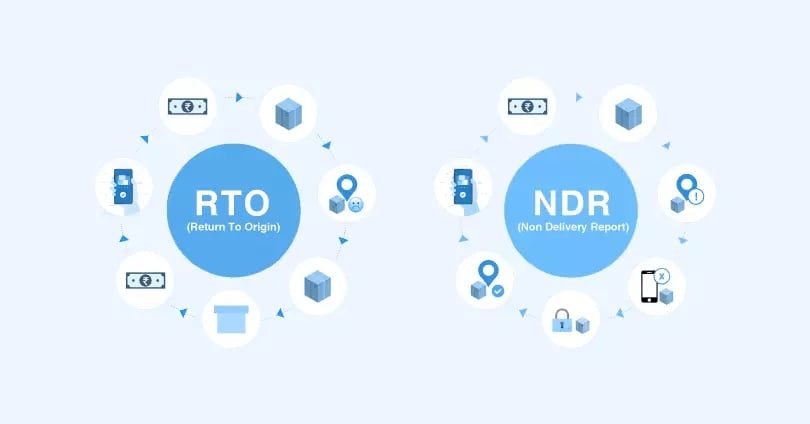
NDR and RTO in e-commerce are the two most operationally disruptive and financially damaging outcomes in last-mile delivery. Non-Delivery Reports (NDRs) occur when a shipment fails to reach the customer on the first or a subsequent delivery attempt. Return to Origin (RTO) occurs when those failures go unresolved, and the carrier ships the package back to the seller.
Together, they impose a compounding cost burden:
-
Double shipping charges on every RTO event
-
Repackaging and quality inspection costs on returned inventory
-
Revenue loss on the original unfulfilled order
-
Customer churn from a poor post-purchase experience
Industry data indicate NDR rates in Indian e-commerce logistics range from 20% to 40%, depending on category and geography. A significant share of those NDRs convert to RTO within 24 to 72 hours when left unmanaged. This guide covers the mechanics of both metrics, their financial consequences, and the interventions that reduce them.
What Is NDR in E-Commerce? Definition and Common Causes
An NDR, or Non-Delivery Report, is a carrier-generated notification raised when a shipment cannot be delivered on a given attempt. It is an intermediate exception status, not a terminal outcome. The window between an NDR event and an RTO conversion is where operations teams can intervene and recover the shipment.
NDRs fall into four primary categories:
-
Customer unavailability: The customer is not present at the delivery address during the attempt window. This is the single most common NDR trigger across most carrier networks.
-
Incorrect or incomplete address: Missing landmarks, wrong PIN codes, or floor/unit number gaps that prevent the delivery agent from locating the recipient.
-
Failed COD collection: The customer cannot produce the exact payment amount. Especially prevalent in tier-2 and tier-3 markets where COD remains the dominant payment modality.
-
Carrier-side operational failure: Route planning errors, hub capacity overflow, vehicle breakdowns, or restricted-zone access that prevent the delivery attempt altogether.
Each category requires a distinct resolution workflow. An availability-related NDR is resolved through rescheduling; an address-related NDR requires active data correction before reattempt.
The Capgemini Research Institute's Last-Mile Delivery Challenge report identifies last-mile as the most cost-intensive segment of the supply chain, accounting for 41% of total logistics spend, with delivery failures and reattempt cycles representing a disproportionate share of that figure.
What Is RTO in E-Commerce? Definition, Costs, and Impact
RTO, or Return to Origin, occurs when an undelivered shipment is returned to the seller's warehouse after all carrier delivery attempts are exhausted or the NDR resolution window closes without successful delivery. Unlike a customer-initiated return, RTO is an involuntary outcome; it happens without the customer's participation and generates no revenue for the seller.
The cost structure of a single RTO event includes:
-
Forward shipping cost (non-recoverable once the attempt is made)
-
Reverse logistics cost, typically 60–80% of the forward shipping charge
-
Repackaging and quality inspection on the returned unit
-
Inventory holding delay while the item is in transit back to the origin
-
Opportunity cost of the unfulfilled order slot
RTO rates vary significantly by category. Fashion and apparel, which have high COD concentration and elevated return propensity, consistently record RTO rates above 25%. Electronics tend to exhibit lower RTO frequency but higher per-event cost impact due to product value.
India's e-commerce logistics market is projected to reach USD 9.9 billion by 2028, according to IMARC Group. RTO is identified as one of the primary structural cost drivers constraining margin expansion for domestic sellers at scale.
NDR vs RTO: Key Differences Every E-Commerce Seller Should Know
NDR and RTO are sequential events on the same failure pathway, not independent metrics. Treating them as separate problems leads to misallocated resources and incorrect SLA design.
The core distinctions:
-
Timing: NDR is raised immediately after a failed delivery attempt. RTO is initiated after the NDR resolution window expires, typically 24 to 72 hours later.
-
Reversibility: NDR is recoverable through timely customer outreach and delivery rescheduling. RTO, once initiated by the carrier, is largely irreversible within the same shipment lifecycle.
-
Financial exposure: NDR events carry the cost of a re-attempt. RTO events incur the cost of a reattempt, full reverse logistics, and lost revenue.
-
Operational signal: NDR is a leading indicator; it measures process failure in real time. RTO is a lagging indicator that reflects the cumulative result of unresolved NDR volume.
The most actionable metric for operations teams is the NDR resolution rate: the percentage of NDR events that result in successful delivery rather than RTO. Operations that track only RTO rate are measuring outcomes without visibility into the upstream process failures that drove them. Learn more about how last-mile delivery solutions help supply chain leaders address these gaps.
What Causes High NDR Rates in E-Commerce? 4 Root Causes Explained
High NDR rates reflect compounding failures across the customer acquisition, order management, and carrier execution layers of the supply chain. Each cause requires a distinct intervention.
-
The most common NDR trigger. It results from misaligned delivery expectations when customers don't receive reliable delivery windows; they cannot plan to be present or arrange alternatives.
- Particularly acute in tier-2 and tier-3 zones where carrier ETA accuracy is lower
- Worsened by generic notifications that don't specify delivery windows in hours
- Addressable through day-before and day-of delivery confirmations with rescheduling options. Understanding how to calculate expected delivery dates accurately is a critical first step.
How Incorrect or Incomplete Address Data Triggers NDR Failures
-
Address entry errors at checkout produce a structurally different NDR class that cannot be resolved by reattempt alone. The root cause is usually:
- Missing landmarks and local identifiers in areas without precise geocoding
- Incorrect PIN codes entered at checkout without real-time validation
- No unit or floor number for multi-dwelling residential buildings
Why Failed COD Collection Causes NDR Spikes
-
Customers who are unable to provide the exact payment amount at the time of delivery generate COD-related NDRs. These are recoverable but process-intensive.
- Pre-delivery COD reminder messages with the exact amount reduce collection failures.
- COD-to-prepaid conversion nudges before dispatch address the issue upstream.
Carrier-Side Operational Failures That Drive NDR Volume
-
Route planning errors, hub delays, and restricted delivery zones generate NDRs outside the seller's control but still require active management to prevent automatic RTO escalation.
-
Research from Statista indicates that last-mile delivery failures account for 53% of total logistics costs in e-commerce operations, with delivery exception management identified as the primary lever for cost reduction.
-
McKinsey says that 13% to 19% of logistics costs can stem from inefficient handovers in mid- and last-mile logistics, which they estimate can amount to $95 billion to $125 billion globally.
What Causes High RTO Rates? The Structural Drivers Behind Return to Origin
High RTO rates are the downstream product of unresolved NDR volume, but the specific mechanisms vary. The most common structural causes:
Inadequate Post-Purchase Communication Infrastructure
-
Operations relying on carrier-generated notifications alone cannot intervene in the NDR window effectively
-
Carrier notifications are often delayed, inconsistently formatted, and non-actionable
-
When the first signal a seller receives is an RTO initiation, not the original NDR, the recovery window has closed. A dedicated post-purchase platform provides the real-time visibility needed to intervene before that window closes.
How High COD Concentration Raises RTO Rates
-
COD orders have lower commitment from customers, increasing unavailability and refusal rates
-
COD-heavy SKU mixes without pre-delivery confirmation workflows structurally elevate RTO.
COD orders are significantly more likely to result in RTO than prepaid orders, with industry reporting showing COD return rates around 26% versus under 2% for prepaid orders, making payment mode a major driver of order-level RTO risk. For a deeper look at how this plays out across verticals, see our analysis of RTO in health and wellness brands.
Geographic Concentration in High-Failure Delivery Zones
-
Specific PIN codes and carrier hubs consistently produce above-average NDR and RTO rates.
-
Infrastructure constraints, security restrictions, or capacity limits drive zone-specific failure.
-
Operations that don't segment RTO by geography cannot identify or act on these structural hotspots. Reviewing last-mile delivery statistics by zone can surface which areas require carrier reallocation.
No RTO Prediction Layer at Order Creation
-
Without risk scoring at order creation, high-RTO shipments are processed the same as low-RTO ones.
-
Predictive models that flag risk before dispatch enable upstream intervention rather than downstream remediation. AI and machine learning in carrier allocation are increasingly used to build these risk layers at scale.
How to Reduce NDR in E-Commerce: Proven Strategies That Work
NDR reduction requires interventions at three distinct stages: before the delivery attempt, at the moment of exception, and during the resolution window.
Pre-Delivery Customer Preparation to Prevent NDR Events
-
Send day-before delivery notifications with a specific time window, carrier name, and one-tap rescheduling option.
-
Use WhatsApp and SMS as primary channels; they deliver materially higher engagement than email, particularly in tier-2 and tier-3 markets.
-
For COD orders, include the exact amount due in the pre-delivery message to reduce collection failures at the door
-
Enable customers to provide delivery instructions (gate code, alternate contact, preferred drop location) before the attempt
Real-Time NDR Alert Systems and Automated Exception Management
-
Carrier API integration that surfaces NDR events within minutes of generation, not hours. Last-mile carrier tracking tools with direct API connections are the foundation of any real-time alert system.
-
Automated customer outreach triggered immediately after an NDR event via structured IVR or WhatsApp
-
Reattempt scheduling is built into the outreach flow so the customer can confirm a window without calling support
Address Correction Workflows That Recover Failed Deliveries
-
Automatically flag address-related NDRs and trigger a structured customer message requesting corrected information
-
Communicate corrected address data to the carrier before the next reattempt. Most carriers hold NDR shipments at the local hub for 24–72 hours
-
Implement PIN-code-level address validation at checkout to reduce address-error NDRs at source
How to Reduce RTO in E-Commerce: Strategies That Actually Lower Return to Origin Rates
RTO reduction is most effectively approached as an extension of NDR management. Every NDR that converts to a successful delivery prevents an RTO. Beyond NDR resolution, upstream interventions address the systemic conditions that generate high failure volume.
How RTO Prediction Scoring Cuts Return to Origin Before It Happens
-
Assign a risk score to each shipment at order creation based on destination PIN code history, carrier, product category, and payment modality
-
Route high-risk shipments to higher-reliability carriers automatically using intelligent carrier allocation
-
Flag high-risk COD orders for pre-dispatch customer confirmation calls before the shipment is processed
-
Predictive intervention shifts cost from post-failure remediation to pre-failure prevention
COD-to-Prepaid Conversion: The Highest-ROI RTO Reduction Strategy
-
Customers who convert from COD to prepaid before dispatch have demonstrated payment commitment, which directly reduces refusal and unavailability rates
-
Conversion incentives, such as a small discount or reward points, are frequently cost-effective relative to the avoided RTO cost
-
Approximately 58% of COD/non-prepaid orders end up as RTOs, and as the RTO rises, delivery slows down.
Carrier Diversification by Zone to Minimize Delivery Failure Rates
-
Maintain a multi-carrier allocation model in which carrier assignments are dynamically optimized for delivery success rate at the PIN-code level
-
Do not allocate all shipments to a single carrier based on rate alone. Delivery reliability variance between carriers at the PIN-code level is substantial. For a detailed breakdown, see single carrier vs multi-carrier shipping.
-
Review carrier-level NDR and RTO data quarterly and reallocate zones based on current performance, not contract defaults
The Real Financial Impact of NDR and RTO on E-Commerce Profitability
The financial impact of NDR and RTO extends well beyond direct shipping costs. At scale, these metrics impose a compounding margin drag that grows with order volume and is disproportionately severe in low-ASP categories.
Direct Per-Event Costs of NDR and RTO Failures
-
Forward shipping cost: non-recoverable once the delivery attempt is made
-
Reverse logistics cost: typically 60–80% of forward shipping, adding a second charge to an order that generated zero revenue. See the full breakdown of e-commerce logistics costs to understand how RTO fits into total cost structure.
-
Repackaging and QC inspection on the returned unit
-
In weight-sensitive or perishable categories, a single RTO can produce a net-negative unit economics outcome
How NDR and RTO Erode Gross Margin at Scale
McKinsey says reverse logistics is a major cost burden in retail and apparel, with retailers spending about $200 billion annually on processing returns and recovering value, making returns management a significant margin issue. E-commerce operations with elevated RTO rates are at the high end of this range due to the unplanned nature of returns and the lack of retail-store absorption infrastructure.
-
Operations with NDR rates above 30% and low resolution rates can see RTO-related costs consume 5–8 percentage points of gross margin
-
Two to five percentage points of gross margin is the typical RTO drag for mid-scale operations with moderate COD exposure
How Failed Deliveries Damage Customer Lifetime Value and Repeat Purchase Rate
-
Customers who experience delivery failure and receive no proactive communication are materially less likely to reorder
-
Post-purchase experience is a documented driver of repeat purchase intent — an unmanaged NDR produces the same negative perception as a product quality failure. Post-purchase strategies for e-commerce brands increasingly treat NDR communication as a retention tool, not just a logistics function.
-
In high-CAC categories, protecting repeat purchase rate through post-purchase experience is a direct margin defense
Ipsos found that 85% of online shoppers say a poor delivery experience would stop them from ordering again from that retailer, highlighting how failed delivery can directly undermine repeat-purchase intent.
How ClickPost Helps You Take Control of NDR and RTO Performance
For supply chain and e-commerce operations leaders managing multi-carrier fulfillment at scale, NDR and RTO are not peripheral metrics; they are core profitability levers that directly determine whether post-purchase operations generate or erode margin.
ClickPost is a post-purchase logistics intelligence platform purpose-built for this challenge. Its NDR management product,
ClickPost's NDR management product, Parth, integrates directly with your carrier network to:
-
Surface NDR events in real time within minutes of carrier generation, not hours
-
Trigger structured customer outreach via WhatsApp, SMS, and IVR immediately after a failed attempt
-
Provide delivery rescheduling and address correction workflows that maximize NDR-to-successful-delivery conversion
-
Score each shipment at dispatch for RTO risk, enabling proactive routing and COD verification for high-risk orders before they generate NDR volume
Operations teams using ClickPost report measurable improvements in NDR resolution rate, RTO rate, and customer post-purchase satisfaction scores across their carrier networks, with results visible within the first shipment cohort after implementation.
If your current NDR and RTO rates are constraining fulfillment margin or repeat purchase rate, the path forward starts with understanding where your exception management process is breaking down. Schedule a demo with ClickPost today to see how Parth transforms post-purchase operations.
NDR and RTO Management: The Three Principles That Separate High-Performance Operations
NDR and RTO are the two most consequential failure events in e-commerce post-purchase logistics, and they are causally linked: unresolved NDRs are the primary feed into RTO volume. For operations leaders, the implication is clear: the most efficient place to intervene is at the NDR stage, before conversion to RTO and costs compound.
Three principles govern high-performance NDR and RTO management:
-
Speed of response: The NDR resolution window is 24–72 hours. Operations with automated, real-time alerting and customer outreach outperform those with manual, batch-based processes by a factor of 3 to 5 in conversion rate.
-
Root cause segmentation: Availability-related NDRs, address-related NDRs, and COD failures each require distinct workflows. Uniform responses to categorically different failures produce suboptimal outcomes.
-
Upstream prevention: RTO prediction scoring, COD-to-prepaid conversion, and strategies to reduce RTO rates like carrier diversification by zone address the structural conditions that lead to high failure rates before the shipment leaves the warehouse.
Operations that systematically instrument these three principles with real-time data, automated workflows, and predictive modeling consistently outperform their peers in delivery success rate, reverse logistics cost, and customer repeat purchase rate. The tools and strategies covered in this guide provide the operational foundation. Implementation is the differentiator.
Frequently Asked Questions About NDR and RTO in E-Commerce
What is NDR in e-commerce and how does it affect sellers?
An NDR (Non-Delivery Report) is a carrier-generated notification raised when a shipment cannot be delivered to the end customer on a given attempt. It is an intermediate exception status, not a terminal event. Active resolution within the carrier's window can convert an NDR into a successful delivery and prevent RTO escalation.
What is RTO in e-commerce and why does it cost sellers so much?
RTO (Return to Origin) occurs when an undelivered shipment is returned to the seller's warehouse after all carrier delivery attempts have been exhausted or the NDR resolution window expires without successful delivery. It results in double shipping costs and zero revenue from the original order.
What is the difference between NDR and RTO in e-commerce?
NDR is a recoverable delivery failure event. RTO is the irreversible financial outcome of an unresolved NDR. NDR is a leading process indicator; RTO is a lagging cost outcome. Tracking NDR resolution rate, not just RTO rate, is a more actionable performance metric for operations teams.
What are the main causes of high NDR rates in e-commerce?
The primary causes are customer unavailability at delivery, incorrect or incomplete address data entered at checkout, failed COD payment collection, and carrier-side operational failures, such as route-planning errors or hub capacity constraints. Each cause requires a distinct resolution workflow.
How does an NDR lead to RTO if left unresolved?
When an NDR is raised, and the seller or carrier cannot reach the customer to reschedule or resolve the exception within the carrier's allotted window, typically 24 to 72 hours, the carrier automatically initiates the return leg. NDR converts to RTO by default when no active intervention occurs.
What is a good NDR rate benchmark for an e-commerce operation?
Operations targeting tier-1 zones with strong prepaid order mix should aim for NDR rates below 10%. Operations with significant COD volume or tier-2/tier-3 geographic concentration should target below 20%, with NDR-to-successful-delivery conversion rates above 50% as a secondary benchmark.
How can I reduce RTO rate in my e-commerce operation?
The highest-impact strategies are: maximizing NDR resolution rate through automated customer outreach, implementing RTO prediction scoring at order creation, enabling COD-to-prepaid conversion workflows, and using carrier performance data at the PIN-code level to optimize zone-level carrier allocation.
Does COD increase RTO risk in Indian e-commerce?
Yes, significantly. COD orders generate RTO rates two to three times higher than prepaid orders on comparable routes, according to Shiprocket's industry analysis. The lower payment commitment inherent in COD increases customer unavailability and refusal rates. Pre-delivery COD confirmation messages and conversion nudges materially reduce this risk.
What is NDR resolution rate and why does it matter more than RTO rate alone?
The NDR resolution rate is the percentage of NDR events that result in successful delivery rather than RTO. It is a leading indicator of post-purchase operational health. Operations with automated NDR resolution workflows achieve conversion rates of 40–60%; manual processes achieve 10–20%. A higher resolution rate directly reduces RTO volume and reverse logistics cost.
How does ClickPost help reduce NDR and RTO rates?
ClickPost's Parth platform provides automated NDR management with real-time carrier alerts, structured customer outreach via WhatsApp and IVR, delivery rescheduling workflows, address correction capabilities, and RTO prediction scoring at the order level. It integrates across multi-carrier networks to give operations teams a unified post-purchase exception management layer.