%20%20-%20Menu.svg)




.png?width=879&height=549&name=Page%2074%20(1).png)
Average Add-to-Cart Rate in Ecommerce (2026): Industry Benchmarks & Insights



In this blog
TL;DR Summary
Add-to-cart rate measures the percentage of ecommerce sessions in which shoppers add at least one item to their cart, signaling purchase intent before checkout friction begins.
-
Global average add-to-cart rate is 5.96%, with the top 10% of Shopify stores exceeding 9.6%, according to Dynamic Yield by Mastercard.
-
Mobile drives 77% of retail site traffic in 2025, yet a 3-second page load delay causes 53% of mobile visitors to abandon, directly suppressing cart additions.
-
Food and Beverage leads all categories at 9.55% ATC rate, while Luxury and Jewelry lag at 2.15% because higher purchase stakes demand stronger trust signals.
-
Showing estimated delivery dates on product pages increased PDP conversion rate by 5% for Hopscotch after implementing ClickPost's pincode-level ML predictions.
-
A high ATC rate paired with a 70.19% global cart abandonment rate signals checkout friction rather than product page failure, requiring separate diagnostic action.
What Is Add-to-Cart Rate and Why Does It Matter in 2026?
Add-to-cart rate is one of the most actionable metrics in ecommerce and one of the most misread. Brands that treat it as a simple health indicator miss what it actually reveals: whether your product pages, pricing, delivery promises, and trust signals are strong enough to move shoppers forward before checkout friction even begins.
The global average ecommerce conversion rate fell from 1.77% in March 2025 to 1.64% in March 2026—a 7.36% year-over-year decline, making it more important than ever to diagnose exactly where shoppers are dropping off.
A low add-to-cart rate points to a product page or a traffic problem. A high add-to-cart rate paired with low conversion points to a checkout problem. Knowing which one you are dealing with determines where you should focus.
This guide covers the 2026 benchmarks, the formula, what the numbers mean by category, device, and region, and the specific levers that move the metric in the right direction.
Add-to-Cart Rate in Ecommerce: Definition, Formula, and How to Use It
Add-to-cart rate is the percentage of ecommerce sessions or product page visits where a shopper adds at least one item to the cart. It measures purchase intent before checkout and helps brands identify whether product pages, pricing, estimated delivery promises, or trust signals are strong enough to move shoppers forward.
It separates browsers from buyers before checkout friction sets in. The average ecommerce conversion rate fell from 1.77% in March 2025 to 1.64% in March 2026, a 7.36% year-over-year decline. In a tighter conversion environment, identifying where shoppers drop off before checkout matters more than ever.
How to Calculate Add-to-Cart Rate: The Formula Explained
Add-to-cart rate = (Sessions with at least one add-to-cart action / Total sessions or product page sessions) x 100
The denominator matters. Using different denominators across reports creates misleading comparisons. Agree on one definition and apply it consistently:
-
Total site sessions: Use when measuring overall funnel health.
-
Product page sessions: Use when measuring PDP-level effectiveness.
-
Unique users: Use when measuring shopper-level behavior across multiple visits.
-
Total add-to-cart events: Use when measuring merchandising momentum.
Why Add-to-Cart Rate Is a Better Early-Funnel Signal Than Conversion Rate
Add-to-cart rate tells teams where the funnel problem actually sits:
-
Low ATC and conversion rates usually point to issues before checkout: weak product pages, unclear pricing, poor traffic quality, missing delivery promises, or low trust signals.
-
High ATC rate and low conversion rate usually point to issues after the cart: high shipping costs, slow delivery times, limited payment options, or checkout friction.
Pair it with cart abandonment rate, checkout initiation rate, checkout completion rate, bounce rate, and revenue per visitor for a complete picture.
Monthly Add-to-Cart Rate Benchmarks: November 2024 to March 2026
The table below covers the period from November 2024 to March 2026. ATC rate figures vary by campaign activity, category mix, and traffic quality. The global baseline of 5.96% is sourced from Dynamic Yield by Mastercard. Seasonal patterns are drawn from IRP Commerce and Contentsquare's 2025 Digital Experience Benchmark, based on 90 billion user sessions.
| Month | ATC Rate (Directional) | Conversion Rate | Seasonal Driver |
| Nov 2024 | 8% to 9% | Above baseline | Holiday gifting, Black Friday, Cyber Monday |
| Dec 2024 | 7% to 8% | Elevated | Holiday continuation, year-end gifting |
| Jan 2025 | 4% to 5% | Softens | Post-holiday demand drop, returns season |
| Feb 2025 | 5% to 6% | Moderate | Valentine's Day lift in fashion and gifting |
| Mar 2025 | 4% to 5% | 1.77% (verified) | Seasonal soft period |
| Apr 2025 | 5% to 6% | Moderate | Spring and summer prep, beauty, and fashion |
| May 2025 | 5% to 6% | Moderate | Mid-year sale activity |
| Jun 2025 | 4% to 5% | Softens | Pre-summer slowdown in some markets |
| Jul 2025 | 4% to 5% | Low | Mid-year lull, back-to-school starts |
| Aug 2025 | 4% to 5% | Low | Pre-festive buildup, traffic rises but intent lags |
| Sep 2025 | 5% to 6% | Recovering | Festive season teasers, fashion, and electronics pick up |
| Oct 2025 | 7% to 8% | Above baseline | Festive peak, Navratri, Diwali run-up, early holiday |
| Nov 2025 | 8% to 9% | Highest months | Black Friday, Cyber Monday, holiday gifting |
| Dec 2025 | 7% to 8% | Elevated | Year-end clearance and gifting continuation |
| Jan 2026 | 4% to 5% | Softens | Post-holiday drop, returns season |
| Feb 2026 | 5% to 6% | Moderate | Valentine's Day and early spring lift |
| Mar 2026 | 4% to 5% | 1.64% (verified) | Seasonal soft period, conversion rate down 7.36% YoY |
Source: IRP Commerce | Dynamic Yield | Contentsquare
November is consistently the strongest month for the ATC rate. March through August is the right time to sharpen PDP content and mobile UX, and to improve visibility into the delivery promise before the next festive cycle begins.
Add-to-Cart Rate Benchmark Data 2026: Global, Industry, Device, and Region
Global and Platform Averages
-
Global average ATC rate: 5.96%
-
Average Shopify ATC rate: 4.6%
-
Top 20% of Shopify stores: above 7.5%
-
Top 10% of Shopify stores: above 9.6%
-
Typical ecommerce ATC range: 2% to 10%
-
Global cart abandonment rate: 70.19%
-
Shoppers who abandon due to extra costs: 39%
-
Shoppers who abandon because delivery is too slow: 21%
-
Shoppers who abandon because the returns policy is unsatisfactory: 15%
Add-to-Cart Rate by Industry: Which Ecommerce Categories Perform Best?
| Industry | ATC Rate |
| Food and Beverage | 9.55% (12-month avg) |
| Beauty and Personal Care | 6% to 8% (directional) |
| Fashion and Apparel | 5.4% (Shopify avg) |
| Consumer Goods | 5% to 7% (directional) |
| Home and Furniture | 3% to 5% (directional) |
| Luxury and Jewelry | 2.15% (12-month avg) |
Source: Dynamic Yield | Littledata
Everyday repeat-purchase categories see higher ATC rates because the cost of being wrong is lower. High-ticket categories see lower rates because shoppers need more proof, more time, and stronger trust signals. For fashion brands in particular, multi-carrier shipping reliability and clear return policies are key differentiators.
Add-to-Cart Rate by Device: Why Mobile Optimization Can't Wait
| Device | ATC Rate |
| Mobile | 6.19% |
| Tablet | 5.98% |
| Desktop | 5.22% |
Source: Dynamic Yield
Mobile leads desktop in ATC rate. 77% of retail site traffic in 2025 came from mobile, meaning a small drop in mobile ATC rate has an outsized impact on revenue. 53% of mobile visitors leave pages that take longer than three seconds to load. Brands investing in ecommerce automation often find that faster page experiences and dynamic content delivery have the most direct impact on mobile ATC improvement.
Add-to-Cart Rate by Region: How EMEA, Americas, and APAC Compare
| Region | ATC Rate |
| EMEA | 6.40% |
| Americas | 5.95% |
| APAC | 3.49% |
Source: Dynamic Yield
Regional differences reflect payment habits, delivery expectations, and ecommerce maturity. For global brands with traffic across India, the US, the UK, the UAE, Australia, or Southeast Asia, compare ATC rates by market rather than applying a single global rate. Understanding ecommerce logistics infrastructure and same-day delivery availability in each market helps explain why APAC lags despite high mobile usage.
What Is a Good Add-to-Cart Rate for Ecommerce in 2026?
A good add-to-cart rate depends on your category, device mix, region, and traffic source. There is no single universal number.
| ATC Rate Range | What It Suggests |
| Below 2% | Likely a product page, pricing, trust, or traffic quality issue |
| 2% to 4% | Below typical for most categories; investigate before scaling spend |
| 4% to 6% | Common range for most Shopify and ecommerce stores |
| 7% to 10% | Strong performance for most categories |
| Above 10% | Strong purchase intent; monitor checkout completion and abandonment closely |
A high ATC rate paired with a high cart abandonment rate is not automatically healthy. The global cart abandonment rate is 70.19%, meaning most shoppers who add to cart still do not complete the purchase. Reviewing detailed cart abandonment statistics by category and device can help you isolate where post-cart drop-off is highest.
Diagnostic Matrix: What Your ATC Rate Is Really Telling You
| Pattern | What It May Mean | What to Check First | What to Fix |
| Low ATC, low conversion | PDP weakness or traffic mismatch | Product imagery, price, delivery promise, page speed | PDP content, campaign alignment, faster load times |
| High ATC, low conversion | Checkout friction | Shipping costs, delivery date, payment options, and return policy | Transparent delivery dates, fewer checkout fields, and payment diversity |
| High ATC, high abandonment | Expectations break at the cart | Hidden costs, delivery time, and account creation requirements | Upfront cost display, guest checkout, cart-level delivery dates |
| Low mobile ATC vs. desktop ATC | Mobile UX issue | Sticky CTA, variant selector, image load, page speed | Mobile PDP redesign, speed optimization |
| High ATC, high RTO or returns | Expectation gap post-purchase | Size guides, product descriptions, and COD verification | Better PDP content, NDR workflows, and return reason analytics |
How to Improve Add-to-Cart Rate: 6 Proven Tactics for Ecommerce Brands
1. Fix the Product Page First
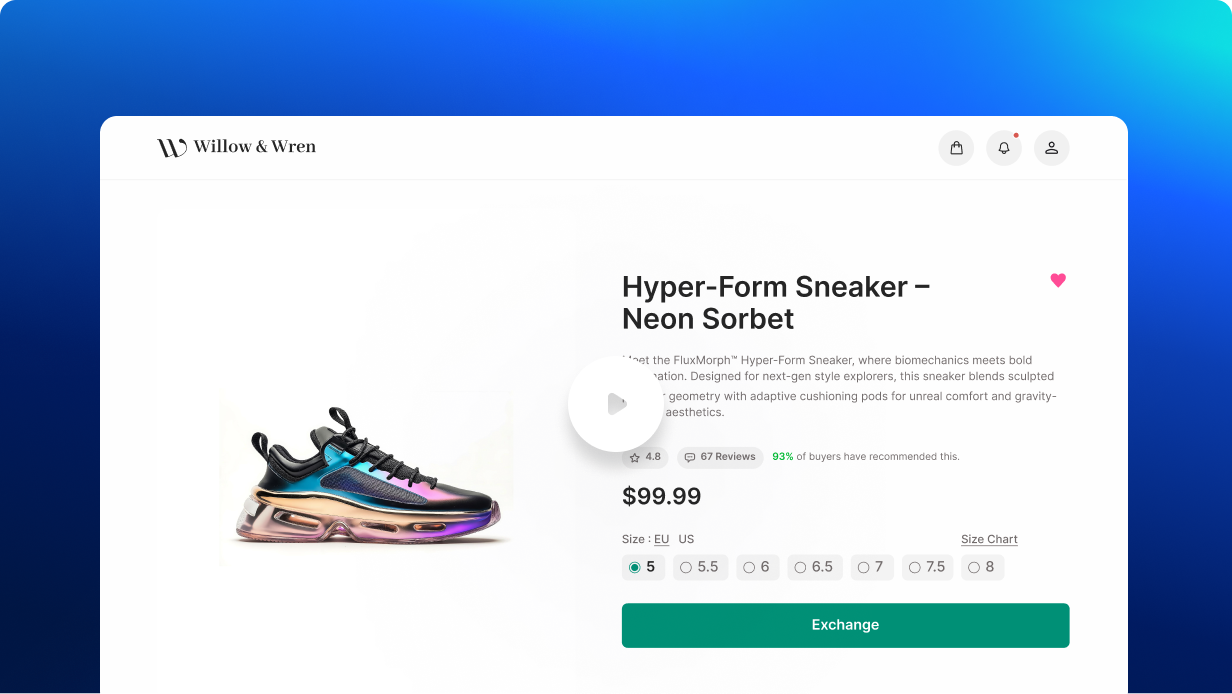
Only 49% of ecommerce sites have decent or good product page UX, while 51% are mediocre or worse. A high-converting PDP should surface the following without requiring the shopper to scroll far: high-resolution images from multiple angles; a size guide or fit recommendation; in-stock status; available variations with clear pricing, including any offers; an estimated delivery date; a return and exchange policy summary; and a star rating with easy access to reviews. Investing in the right store building and design tools makes it easier to structure PDP layouts that convert.
2. Show Estimated Delivery Dates on the Product Page to Reduce Pre-Cart Hesitation
Delivery date visibility is a PDP decision factor, not just a checkout feature. 21% of checkout abandonment is due to slow delivery, and that hesitation often starts on the PDP. ClickPost's Estimated Delivery Dates uses pincode-level ML predictions to surface reliable delivery promises at the product page level. Hopscotch saw a 5% increase in PDP conversion rate after implementing this. Understanding how to calculate an expected date of delivery accurately is the foundation of building shopper trust before checkout begins.
3. Improve Mobile Page Speed and Product Page Layout
53% of mobile site visitors leave pages that take longer than three seconds to load. Prioritize: a sticky add-to-cart button visible without scrolling, compressed product images, variant selectors that are easy to tap on small screens, and reviews, delivery estimates, and the return policy placed near the CTA. Brands using real-time tracking for fashion stores often find that surfacing post-purchase visibility early—including on PDPs—reduces mobile bounce rates as well.
4. Place Trust Signals Near the Add-to-Cart Button
Trust signals work best when placed close to the CTA. These include verified reviews and star ratings, estimated delivery date, key terms of the return and exchange policy, product warranty or guarantee, COD availability where relevant, and secure payment icons.
5. Fix Product Discovery Before Fixing Checkout
Two-thirds of ecommerce sites perform at a mediocre or worse level in product list usability. Shoppers cannot add to the cart what they cannot find. Audit filters, sort options, site search relevance, and product card information before investing further in PDP changes. Tightening your inventory management also prevents high-intent pages from showing out-of-stock items that kill the ATC opportunity entirely.
6. Reduce Delivery and Return Uncertainty Before the Shopper Reaches Checkout
15% of shoppers abandon checkout because the return policy is unsatisfactory. Clear return and exchange policies on the PDP reduce pre-cart hesitation, particularly for fashion and apparel. A transparent shipping policy page linked from the PDP also reduces friction for first-time buyers. ClickPost's Returns and Exchanges product helps brands create exchange-first flows that reduce revenue loss and improve post-purchase confidence. Brands looking to reduce ecommerce return rates find that pre-cart clarity about return conditions is far more effective than post-purchase policies alone.
How ClickPost Helps Ecommerce Brands Improve Purchase Confidence and Add-to-Cart Rate
A shopper is more likely to move forward when the product page answers their key questions: when will this arrive, what happens if it does not fit, and will I get updates after I pay? ClickPost helps brands improve that confidence with pincode-level Estimated Delivery Dates, real-time Shipment Tracking, Branded Tracking Pages, automated Notifications via SMS, email, and WhatsApp, Returns and Exchanges, AI Carrier Allocation, NDR Management, and Logistics Analytics. Brands using a dedicated post-purchase platform gain the visibility and control needed to close the gap between cart additions and completed purchases. It is the platform brands graduate to when basic ecommerce shipping software no longer provides enough visibility or control.
Book a demo to know more about ClickPost.
Conclusion: Add-to-Cart Rate Is a Confidence Metric, Not Just a PDP Metric
Add-to-cart rate is not just a product page metric. It is a confidence metric. The strongest ecommerce brands improve it by connecting PDP quality, mobile UX, price clarity, delivery promises, return confidence, and post-purchase experience visibility into a single coherent experience. When the entire purchase journey works as shoppers expect, the add-to-cart rate takes care of itself.
Frequently Asked Questions About Add-to-Cart Rate in Ecommerce
What is the add-to-cart rate in ecommerce?
Add-to-cart rate is the percentage of ecommerce sessions or product page visits where a shopper adds at least one item to the cart. It measures purchase intent before checkout begins and helps brands identify whether product pages, pricing, delivery promises, or trust signals are strong enough to move shoppers forward.
How do you calculate the add-to-cart rate for an ecommerce store?
Divide sessions with at least one add-to-cart action by total sessions (or product page sessions), then multiply by 100. Use total sessions for overall funnel health, and product page sessions for PDP performance specifically.
What is a good add-to-cart rate for ecommerce in 2026?
A good rate depends on category, device, region, and traffic quality. As a rough reference, 2% to 10% is a common range in ecommerce. Shopify stores above 7.5% are in the top 20%. Compare within your product category and against your own historical trend rather than a single global number.
What is the average add-to-cart rate globally and by Shopify?
The global average is 5.96%, with Food and Beverage at 9.55% and Luxury and Jewelry at 2.15%. The average Shopify ATC rate is 4.6%.
What is the difference between add-to-cart rate and ecommerce conversion rate?
Add-to-cart rate measures the percentage of sessions in which at least one item is added to the cart. Conversion rate measures the percentage of sessions that result in a completed purchase. The gap between the two reflects checkout friction, cart abandonment, and post-cart drop-off.
Why is my add-to-cart rate low? Common causes and fixes
Common causes include weak product content, unclear pricing, missing estimated delivery date information, slow mobile pages, poor review coverage, limited payment options, unclear return policies, or traffic that does not match the product page intent. Reviewing your shipping delays history can also reveal whether reliability concerns are suppressing shopper intent before the cart.
Does mobile page speed affect add-to-cart rate?
Yes. 53% of mobile visitors leave pages that take longer than three seconds to load. Slow mobile pages reduce ATC rate before shoppers even evaluate the product.
Does showing estimated delivery dates on product pages improve add-to-cart rate?
Yes. Delivery date visibility reduces uncertainty before checkout. When shoppers know when an order will arrive, they are more likely to trust the purchase, especially for fashion, beauty, gifting, and urgent-use categories. Brands that display pincode-level expected delivery dates on PDPs consistently see lower pre-cart drop-off.
How do shipping costs affect add-to-cart behavior and cart abandonment?
39% of shoppers abandon checkout because of extra costs. When shoppers suspect hidden fees, they hesitate to add items to their cart. Showing total cost transparency early reduces this friction. A clearly communicated shipping policy and flat-rate shipping options can remove the uncertainty that prevents cart additions in the first place.
Which industries have the highest add-to-cart rates in ecommerce?
Food and Beverage leads at a 9.55% 12-month average, followed by Beauty and Personal Care at 6% to 8%. Everyday repeat-purchase categories consistently outperform high-consideration and luxury categories because the cost of being wrong is lower. For fashion and apparel brands looking to close the gap, addressing shipping delays and return confidence are the highest-leverage improvements available.